
 Post by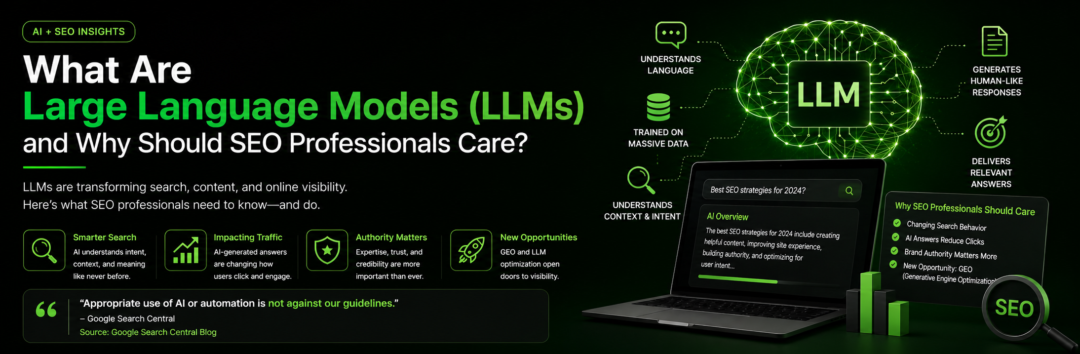
Search is changing faster than ever before. For years, SEO professionals focused on ranking websites on search engine result pages (SERPs). Today, users are increasingly asking questions directly to AI assistants such as ChatGPT, Gemini, and Claude instead of browsing through multiple search results.
Behind these AI systems are Large Language Models (LLMs), a technology that is reshaping how information is discovered, consumed, and recommended online.
For SEO professionals, understanding LLMs is no longer optional. It is becoming a crucial part of maintaining online visibility in the age of AI-driven search.
What Are Large Language Models (LLMs)?
Large Language Models (LLMs) are advanced artificial intelligence systems trained on massive amounts of text data. Their primary purpose is to understand human language, recognize patterns, and generate responses that closely resemble natural human communication.
Popular examples include:
- ChatGPT
- Gemini
- Claude
- Perplexity
- Microsoft Copilot
Unlike traditional search engines that provide a list of links, LLMs attempt to generate complete answers by understanding the user’s intent and synthesizing information from multiple sources.
For example, instead of searching for:
“Best SEO practices for local businesses”
and reviewing several articles, a user may simply ask ChatGPT or Gemini:
“How can I improve local SEO for my business?”
The AI then provides a summarized answer directly.
This shift is changing how users interact with information online.
How Do LLMs Work?
At a basic level, LLMs are trained on billions of words from books, websites, research papers, forums, and other publicly available content.
They learn:
- Language structure
- Context and meaning
- Relationships between concepts
- User intent
- Question-answer patterns
When a user enters a query, the model predicts the most relevant response based on the information it has learned during training and retrieval processes.
Modern AI systems also combine LLMs with search technologies, allowing them to retrieve fresh information from the web before generating answers.
This is why AI-powered search experiences are becoming more useful and accurate.
Why SEO Professionals Should Pay Attention
Many SEO professionals still view AI as just another content creation tool.
That perspective is rapidly becoming outdated.
The bigger impact of LLMs lies in how users discover content.
Search Behavior Is Changing
Users are increasingly asking conversational questions instead of typing short keyword phrases.
Examples:
Traditional Search:
- Best CRM software
- SEO agency near me
- How to start a blog
AI Search:
- What is the best CRM software for a small business?
- Which SEO agency should a local company choose?
- How can I start a profitable blog in 2026?
As search behavior evolves, SEO strategies must evolve as well.
AI Answers Reduce Clicks
Google’s AI-powered search experiences are designed to provide answers directly within search results.
Google explains that AI features such as AI Overviews are becoming part of how users discover information, and website owners should understand how content may appear in these experiences. (Google for Developers)
This means users may get their answers without visiting multiple websites.
As a result:
- Organic click-through rates may decline
- Brand visibility becomes more important
- Being cited as a source matters more than simply ranking
Brand Authority Matters More
LLMs tend to trust and reference websites that demonstrate:
- Expertise
- Authority
- Accuracy
- Consistency
Brands that build strong topical authority are more likely to appear in AI-generated recommendations.
This is one reason why Google’s E-E-A-T principles remain highly relevant.
Google’s Official Position on AI and Content
One of the biggest misconceptions in SEO is that Google automatically penalizes AI-generated content.
Google has officially stated:
“Appropriate use of AI or automation is not against our guidelines.” (Google for Developers)
Google further emphasizes that content should be created primarily for people rather than for manipulating search rankings. (Google for Developers)
Google also notes that generative AI can be useful for research and content structuring, but mass-producing low-value content may violate spam policies. (Google for Developers)
For SEO professionals, this means:
- AI is not the problem
- Poor-quality content is the problem
- Helpful, original, and trustworthy content remains the goal
The Rise of GEO (Generative Engine Optimization)
As AI search grows, a new discipline is emerging:
Generative Engine Optimization (GEO)
GEO focuses on helping content become discoverable and reference-worthy for AI systems.
Instead of optimizing solely for rankings, GEO focuses on:
- Being cited by AI assistants
- Improving entity recognition
- Strengthening topical authority
- Creating highly factual content
- Structuring information clearly
Think of GEO as the next evolution of SEO.
How to Optimize for LLM Visibility
1. Focus on Topical Authority
Create comprehensive content around your niche rather than isolated keyword-focused pages.
2. Build Strong Entity Signals
Help search engines understand:
- Your brand
- Your products
- Your services
- Your expertise
Structured data and schema markup can help.
3. Create Question-Based Content
LLMs frequently answer conversational queries.
Include:
- FAQs
- How-to guides
- Comparisons
- Expert insights
4. Improve Content Accuracy
AI systems prefer trustworthy sources.
Support claims with:
- Research
- Statistics
- Expert opinions
- Case studies
5. Strengthen E-E-A-T Signals
Show:
- Real authors
- Credentials
- Experience
- Industry expertise
These signals help both search engines and AI systems trust your content.
6. Consider llms.txt
An increasing number of websites are exploring llms.txt, a proposed file that helps AI systems understand and access important content more efficiently.
While adoption is still evolving, many SEO professionals are monitoring its potential role in AI search optimization.
What the Future Looks Like
The future of search will likely involve a combination of:
- Traditional SEO
- AI Overviews
- Conversational search
- Generative Engine Optimization
- Voice search
- AI assistants
Rather than replacing SEO, LLMs are expanding it.
The goal is no longer just to rank on page one.
The goal is to become a trusted source that both search engines and AI systems choose to reference.
Conclusion
Large Language Models are transforming the way people find information online. As users increasingly rely on AI assistants for answers, SEO professionals must adapt their strategies beyond traditional keyword rankings.
Understanding how LLMs interpret content, evaluate authority, and generate recommendations will become a key competitive advantage in the coming years.
SEO is no longer only about ranking pages. It is about building trust, authority, and visibility across both search engines and AI-powered answer engines. Businesses that start preparing today will be better positioned to succeed in the next generation of search.